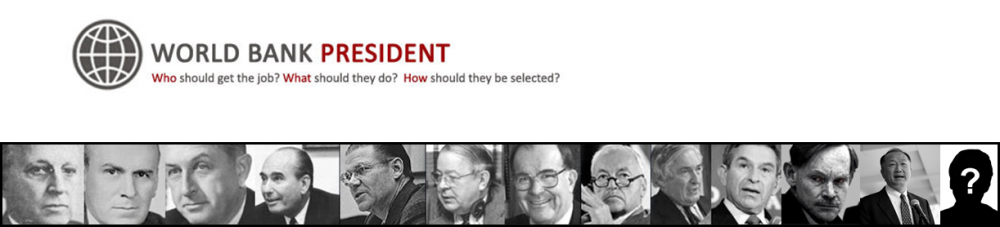
World Bank? You’d better look at the BRICS bank!

Ok, I know that most of you are interested in the changes about to occur in the World Bank but, am sorry to say, this generates very little interest in some of the largest countries of the so called “developing” world.

First, because we all know that the US will nominee the guy to the WB, just as Europe have always done with the IMF. Although some Southern governments, just like Brazil´s, pretend to believe in “reforms” in the Bretton Woods institutions, deep inside they know that winners are already chosen. Continue reading

Will the next World Bank president have ‘official views’?

Amidst all the talk of Jeffrey Sachs’s ‘pick me!’ campaign, Larry Summer’s numerous indiscretions, and the dimming prospect of a BRIC candidate, development consultant Ben Ramalingam offers something a little different. Drawing on work by former Bank staffer and academic David Ellerman he argues that a problem with the Bank is that it has ‘official views’. These views, which the Bank pours energy and resources into coming up with, constitute the Bank’s official line on issues, and become orthodoxies that inhibit genuine learning, country and community ownership, and open dialogue:

adverse opinions and critical reasoning tend to give way to authority, rules and bureaucratic reasoning shaped by the hierarchies within the organisation. Moreover, these Official Views “short-circuit” and bypass the active learning capability of national and local actors, and substitute the authority of external agencies in its place Continue reading

Criteria for choosing Zoellick’s successor

After former World Bank Executive Director Moises Naim weighed in with ‘critical tips’, thoughtful commentary in the FT by former World Bank Vice Presidents, academics Ian Goldin and Danny Leipziger, and a robust rejoinder to Goldin from former World Bank staff member Percy Mistry highlight the issues the world should expect the World Bank’s owners and board to take into account as they prepare a shortlist of three, interview candidates, and select “by consensus” Robert Zoellick’s successor.

Taken together, these contributions enrich the rather bland criteria set out by the board in its announcement of what it will take into account.

What these four notes address is the Bank’s relevance in the modern world. All four hint, or say quite broadly, that there’s a problem, and that ‘something needs to be done’. Continue reading

A BASIC South view: Expectations from a new president of the World Bank

The “BASIC” block of countries, including China, India, Brazil and South-Africa, representing a group of emerging economies have become a strong geopolitical force in global governance. This “political power shift” became apparent during the Copenhagen Climate Conference and has been observed as well in the vote reform within the Bretton Woods Institutions, such as the World Bank and the IMF1. While the US and Europe continue to have a strong and powerful voice within the International Finance Institutions (IFIs) and UN bodies, the BASIC countries are increasingly using their political and economic clout and influence, especially through informal alliances around UNFCCC negotiations, Major Economies Forum (MEF) and shaping of Green Climate Fund.

The world is entering a new period in global politics, where restructuring of global institutions and redesigning of political processes are taking place to incorporate the interests of emerging economies. Even the World Bank has to navigate through this new emerging dynamic, especially on issues like energy strategy, environmental and social safeguards, etc. Continue reading

Poll: Priorities for reform at the World Bank

The World Bank has attracted criticism across the spectrum of its operations. In this poll, we highlight a selection of the concerns campaigning groups have highlighted. Which area(s) do you feel are the ripest for reform by a new World Bank president?  This is not intended to be a comprehensive agenda – suggest other important issues in the comment section at the bottom!

Continue reading