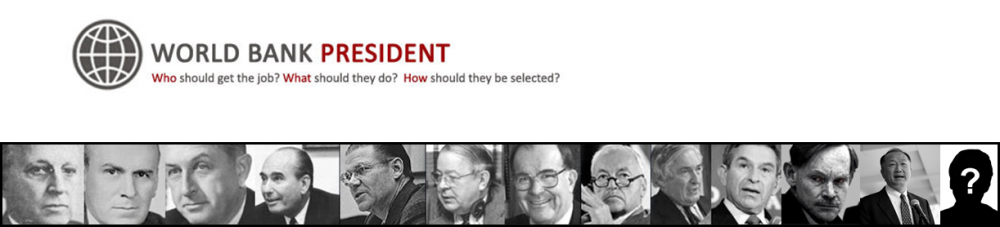
Selection process

The Board said yesterday: “The Board will start the nomination process for a new president immediately.” This implies that it is open to receive candidates right now.

The UK had already publicly committed itself to pushing for a merit-based appointment process. We’re not seeing any signs of this publicly (their line at the moment is “it’s too early to talk about the next president’, but the statement from the Board above would indicate otherwise). Continue reading

This is What the World Bank Looks Like

John Nichols at the Nation says the Wolfowitz “is and always will be the honest face of the World Bank.” Another good tidbit: “[the World Bank is] the global equivalent of a mob enforcer coming in to break the knees of the sovereign nations that do not march to the drum beat of the wealthy nations that own it.” Well if it was the mob, Tony Soprano was the right guy to run it…

UK backtracking?

Despite a written answer to Parliament last week re-stating the UK’s long-standing commitment to ending the gentleman’s agreement for the selection of the heads of the World Bank and the IMF, Hilary Benn’s reaction to the Wolfowitz resignation is prompting worries that the UK has consented to a backroom deal that allows the US to continue to appoint the World Bank’s President. Continue reading

Nonsense about Wolfowitz’s Successor (UPDATE)

Now that June 30th has been fixed as Paul Wolfowitz’s last day at the World Bank, it’s time to talk bluntly about his successor. 

Fortunately, the White House’s initial ludicrous proposal was rebuffed that PW must stay until an (American) successor is in place.  There are perfectly competent people on hand to do the work of the Bank as a thoughtful succession process, driven by the Board and with significant global public input, is followed.  The press nonetheless is speculating about successors, but let’s be careful:  That’s how Paul Wolfowitz picked his entourage and senior staff. 

It’s time to look at the qualifications needed for this important job, at this important time. Continue reading