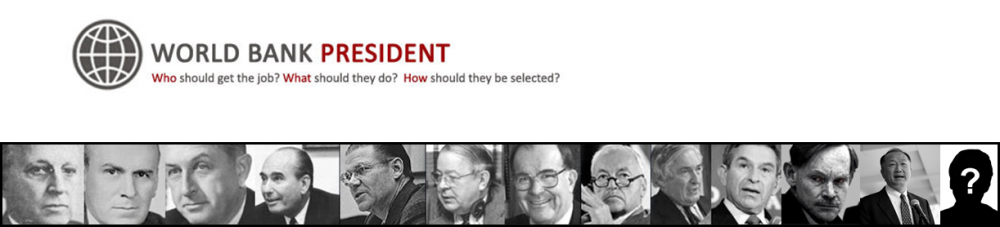
Southern countries step up for the fight: Okonjo-Iweala and Ocampo to be nominated….

… according to a Reuters report:

Nigerian Finance Minister Ngozi Okonjo-Iweala and former Colombian Finance Minister Jose Antonio Ocampo are set to be nominated to lead the World Bank, sources with knowledge of emerging market efforts to find candidates said on Tuesday.

It goes on: Continue reading

Larry Summers the US candidate? Fuggedaboutit!

With the Friday deadline for an American candidate looming, the grapevine is sprouting new fruit at a rapid rate. The latest rumour adds a little chicenery to the mix, with news that Geithner’s leaked list, which included Susan Rice, Larry Summers and John Kerry, actually had decoy names on it! What sneaky smoke and mirrors by the Treasury Secretary! And his grand plan to befuddle the general public was all so his homeboy Larry Summers could land the World Bank job.

Excuse the flippant tone, but these whispers of high level machinations by schemeing string-pullers in Washington have added a little spice to this story. We were all getting a little bogged down in Sachs to be honest. So, it seems that Larry Summers is the only US candidate at present. It’s been well established that Summers is not exactly Mr Popularity, and a new petition and accompanying website, Larry Summers? Fuggedaboutit!, picks up where many an have left off. The site is a playful reminder of Summers’s past indiscretions, with a section called ‘Let them eat waste’ detailing his absurd proposal to outsource pollution to poor countries. At the same time it is serious in its intent Continue reading

Susan Rice candidacy in trouble

Between the idle speculation about various “dream” non-candidates (Lula, Sri Mulyani, Bachelet, Ngozi), the shameless self-promotion by academics (Sachs), and the attacks on Larry Summers after the White House leaked his name a month ago, and the NGOs’ unwillingness to go beyond criticizing the selection process to specify the selection criteria and how to apply them, the rumored White House frontrunner, Susan Rice, is in trouble.

Visibility at the UN is a big asset for an international job.  In some ways it compensates for Dr. Rice’s lack of first-hand experience on development issues, and inexperience at running a big organization in the public sector.

The downside is that you make enemies.  And Russia and China are not the kind of enemies you want if the White House was thinking of you as Robert Zoellick’s successor. Continue reading

With Larry Summers’ World Bank Bid in Trouble, Mexico Insists on Open Process

Early last week the New York Times reported that despite all the previous fine rhetoric about the G20 and consultation and open process, the US Treasury Department had decided to rule by decree and impose its own candidate for the next president of the World Bank, the G20 be damned. U.S. officials informed G20 officials that the US intended to “retain control of the bank,” as the Times put it. According to the Times, the G20 countries grumbled but showed no sign of being willing to fight Treasury. The U.S. candidate would be a “lock,” the Times said, “since Europe will almost certainly support whomever Washington picks.” Continue reading

Discordant NGOs on second favourite Sachs

While some have remarked about the consistency of civil society organisation input on the process, no one can claim that NGOs present a unanimous voice. To spice things up a bit John Cavanagh and Robin Broad wrote about “Why We Are Not Supporting Jeffrey Sachs to be World Bank President” emphasising how his “approach to development remains top-down and formulaic.” Some choice arguments:

This is a moment when we should be actively seeking a candidate from the South—someone who has walked the walk to embrace a bottom-up approach to development. Many names come to mind, including the South Centre’s Martin Khor and Charles Abugre of the UN Millennium Campaign. The so-called gentlemen’s agreement that allows the US government to select an American to head the bank was wrong in the 1940s; it is even more illegitimate now. …

Today, Sachs’s approach to development remains, at its core, top-down and formulaic. Elsewhere, we have critiqued Sachs’s book The End of Poverty for overemphasizing the power of trade and new technologies to put the poorest on a ladder to modernization. (He once famously said, “My concern is not that there are too many sweatshops but that there are too few.”)

Sachs has applied this approach in his well-publicized Millennium Villages in Africa. African colleagues have relayed criticisms that mesh with our own. Through these villages, Sachs has been a promoter of outside money to pay for (among other things) chemical-dependent “green revolution” farming. One village alone is reported to have had a $50,000 a year fertilizer bill. While this undoubtedly can lead to an initial boost in agricultural yields, it is hardly sustainable in the longer run economically (yields dwindle as soils get compacted from chemical inputs), socially (farmers drown in debts), or environmentally (fossil fuel-based chemical fertilizers contribute to climate change).

Sachs was given the right to reply in The Nation, asking “Who else but me among the widely rumored candidates has a record of standing for the poorest of the poor?” he both robustly defends his own track record and resorts to arguing that he is the best of a bad lot. It seems a bit like Republican support for Mitt Romney from a dreadful field of primary candidates for the US presidency, with Sachs writing:

The other US candidates for the position are certainly not development leaders and have no track records fighting poverty. Some have track records quite to the contrary. President Obama, as far as we know, is not considering Martin Khor, but he is considering Larry Summers.

However there is no doubt that Sachs’ candidacy has shaken up the race. Just ask our friends over at Paddy Power. Sachs has jumped to be the second favourite in the race with odds of 3/1. He remains, however, behind Larry Summers, the favourite on 4/11. The other candidate name circulating in the US press, PepsiCo’s Indra Nooyi, doesn’t even get a look-in from Paddy Power.